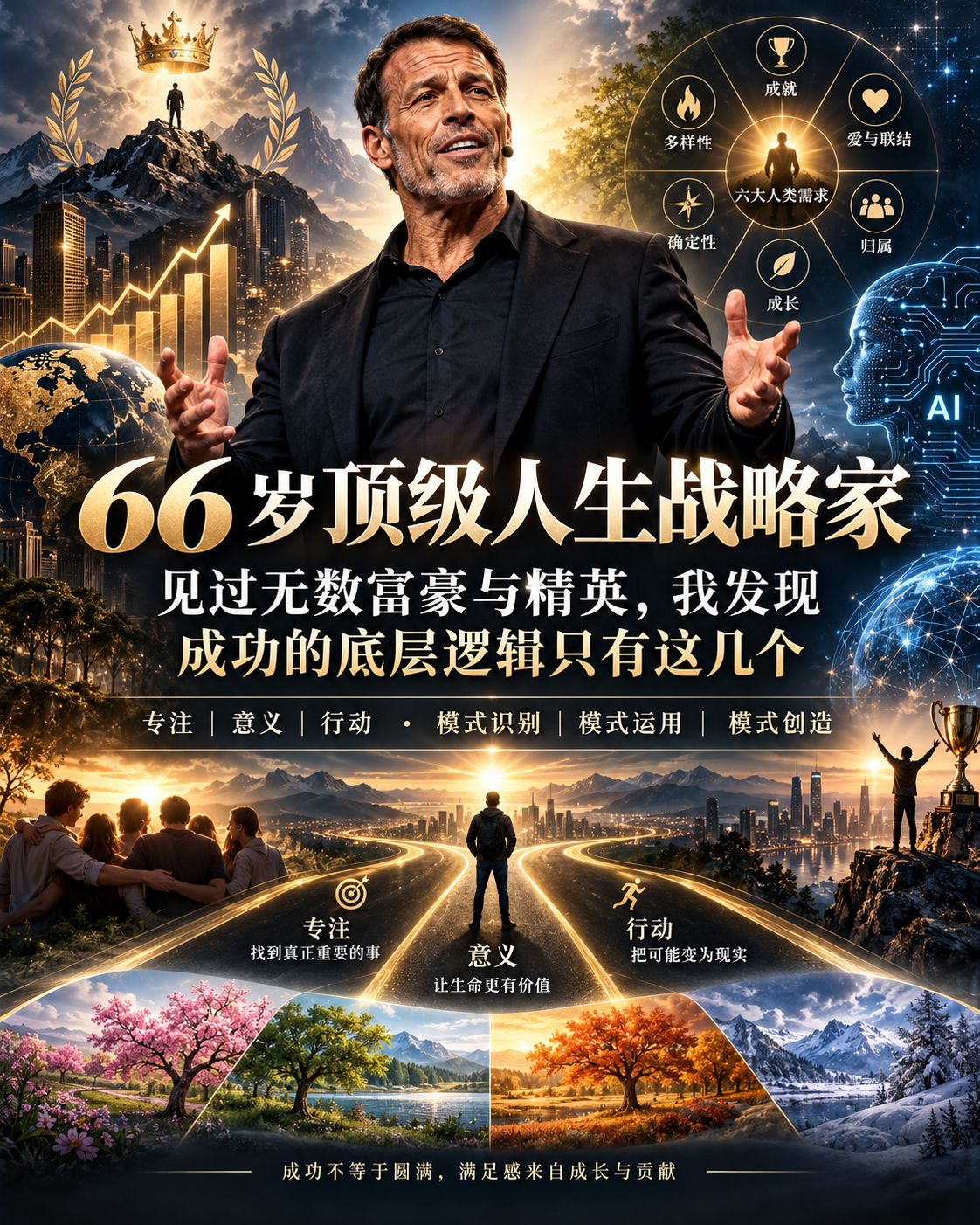
见过皇室、奥运冠军、奥斯卡得主、顶级富豪,也亲历过饥寒交迫的童年。Tony Robbins,全球顶尖人生与商业战略家,用半个世纪的实践,陪伴无数人突破人生困局。
在这一期深度播客访谈里,他聊到人生每一刻的三个关键抉择:关注什么、赋予事件什么意义、采取怎样的行动;也分享精英群体共通的底层特质:模式识别、模式运用、模式创造。财富、事业、亲密关系、内心丰盈,他提醒我们:成功不等于圆满,没有实现自我满足的成就,本质上也是一种失败。
本次访谈关于苦难、成长、财富、AI 时代生存法则。以下内容来自The Diary of A CEO播客 “ No One Is Ready For What’s Coming! Why The Next Decade Will Break People!”
1. 童年创伤与转折点 / Childhood Trauma & The Turning Point
Tony 成长于极度贫困、家暴和混乱的环境,有四个父亲,母亲酗酒、药物成瘾,家庭经常没有食物。改变他一生的时刻是某个感恩节,陌生人送来食物,却被父亲羞辱拒绝。他从这件事中做出了与父亲完全不同的“意义赋予”:父亲认为这是羞辱,他则认为这是来自陌生人的善意。这让他下定决心:“有一天,我要为他人做同样的事。”17 岁时,他第一次用自己的钱为两个家庭送去感恩节食物,从此开启了他一生以“结束苦难”为使命的旅程。
Tony grew up in extreme poverty, abuse, and chaos—four fathers, an alcoholic mother, and frequent food scarcity. The turning point came when a stranger delivered Thanksgiving groceries. His father rejected the gesture with shame, but Tony interpreted it as “a stranger’s care.” He vowed: “Someday, I will do this for others.” At 17, he bought groceries for two families and delivered them anonymously. That moment became the foundation of his lifelong mission: to end suffering wherever he can.
2. 人生的三个决策:专注、意义、行动 / The Three Decisions: Focus, Meaning, Action
-
专注什么:同一件事,可以专注于被羞辱,也可以专注于被帮助。你体验的不是生活本身,而是你选择专注的那部分。
-
赋予什么意义:意义决定情绪。被拒绝可以理解为“我不够好”,也可以理解为“这不是我的机会”。
-
采取什么行动:情绪驱动行动。改变行为的关键是改变前两个决策。
他感恩节的故事完美诠释了这三个决策:父亲专注“被羞辱”,赋予“我养活不了家人”的意义,产生愤怒;他专注“陌生人的善意”,赋予“这个世界有人关心”的意义,产生感激和行动。
Tony believes we make three decisions every moment:
-
What you focus on—you don’t experience life; you experience what you focus on.
-
What you give meaning to—meaning drives emotion.
-
What you do—emotion drives action.
His Thanksgiving story illustrates this perfectly: his father focused on humiliation, gave it the meaning “I’m worthless,” and acted in anger. He focused on kindness, gave it the meaning “strangers care,” and acted with gratitude.
3. 六大人性需求:驱动一切行为的底层力量 / The Six Human Needs: The Forces Behind All Behavior
Tony 提出了六大人性需求,每一个行为都是在某种组合下满足这些需求:
-
确定性(Certainty):安全、稳定、可预测——但也容易导致焦虑。
-
不确定性/多样性(Uncertainty/Variety):惊喜、挑战、变化——避免无聊。
-
重要性(Significance):被认可、独特、有价值——但过度追求会导致孤独和冲突。
-
爱与连接(Love & Connection):归属感、亲密、被无条件接纳。
-
成长(Growth):进化、学习、扩展——不成长则枯萎。
-
贡献(Contribution):超越自我、给予、创造意义。
Tony 指出:如果某件事能满足至少三种需求,你就会对它“上瘾”——无论是积极的(锻炼、服务)还是消极的(抱怨、暴力)。真正的满足来自于将需求排序调整为:先成长和贡献,然后才是爱与连接,而不是被确定性和重要性所驱动。
Tony’s framework for understanding all human behavior:
-
Certainty—security and comfort, but also anxiety.
-
Uncertainty/Variety—surprise and challenge, to avoid boredom.
-
Significance—feeling special and valued, but can lead to isolation.
-
Love & Connection—belonging and unconditional acceptance.
-
Growth—learning and expanding; without it, life withers.
-
Contribution—giving beyond oneself, creating meaning.
He notes that any behavior that meets at least three of these needs becomes addictive—good or bad. True fulfillment comes when you prioritize growth and contribution, not certainty and significance.
4. 改变的核心:故事、状态、策略 / Change: Story, State, Strategy
大多数人想改变时,会先寻找“策略”(怎么做),但这是错误的顺序:
-
首先改变“状态”(State):你的生理和情绪状态决定了你能否执行。状态不对,策略再好也是空谈。
-
其次改变“故事”(Story):你对自己讲的信念——如果故事是“我试过,没用”,你永远不会行动。
-
最后才是“策略”(Strategy):在正确的状态和信念下,策略才会被有效执行。
Tony 强调:改变从来不是能力问题,而是动力问题——当你有足够强的“为什么”,你就能找到“怎么做”。关键在于找到能让你“必须改变”的杠杆(痛苦或快乐)。
Most people try to change by seeking a “strategy” (how)—but that’s the wrong order:
-
First, shift your state—your physiology and emotion; without the right state, strategy is useless.
-
Second, change your story—the belief you hold; if your story is “I’ve tried everything,” you’ll never act.
-
Third, apply the strategy—the right technique only works when state and story are aligned.
He emphasizes:change is never about ability—it’s about having strong enough reasons. Find the leverage (pain or pleasure) that makes change a “must,” not a “should.”
5. AI 与工作消失:最大的社会性痛苦 / AI & Job Displacement: The Biggest Societal Suffering
Tony 认为 AI 引发的劳动力取代是他当前最担心的“大规模苦难来源”。这不仅仅是失去收入,更是失去身份、意义和尊严。他曾在奥巴马任内警告说,仅自动驾驶汽车一项就可能取代美国 800 万个司机岗位,而且几乎没有人在为此进行“再培训”。
他指出,本次转型与历史上农业/工业革命的关键区别在于:速度——变化将在三到十年内发生,而非数百年。他还担心,若人们因失业而失去社会连接和意义感,可能导致大规模暴力。他呼吁政府和企业现在就应开始为人们提供心理和技能上的“再培训”,帮助社会平稳过渡。
Tony views AI-driven job displacement as the biggest looming source of suffering on a global scale. It’s not just lost income—it’s lost identity, dignity, and meaning. He warned President Obama a decade ago that self-driving cars alone could eliminate 8 million US jobs, yet little retooling is happening.
The key difference from historical transitions is speed—this change will happen in 3–10 years, not centuries. Without preparation, he warns of mass violence and psychological devastation. He urges governments and businesses to start retooling people now—both in skills and in psychology.
6. 投资的核心智慧:不对称风险回报 / Investing Wisdom: Asymmetrical Risk-Reward
Tony 访谈了 50 位全球最成功的投资者,发现他们的共同模式是不对称风险-回报:冒很小风险,博很大收益。例如,Paul Tudor Jones 的风险回报比为 1:5——他愿意损失 1 美元,前提是确信能赚 5 美元。这意味着即使他错了 4 次,只要对 1 次,整体仍有收益。
另一个关键点来自 Ray Dalio:找到 8 到 12 个“不相关”的投资组合(如私募股权、私人信贷、房地产等),能减少 80% 的风险,同时保持或提升收益。Tony 强调:人们最大的错误是只关注“赚钱”而不是“不亏钱”——亏 50% 后需要涨 100% 才能回本。
Tony interviewed 50 top investors and found one common pattern: asymmetrical risk-reward—small risk for large upside. Paul Tudor Jones targets a 1:5 ratio—risking $1 for a certain $5 gain, meaning he can be wrong four times and still profit.
Ray Dalio’s key insight: find 8–12 uncorrelated investments (private equity, private credit, real estate). This reduces risk by 80% while maintaining upside. Tony also stresses: the biggest mistake is focusing on “making money” instead of “not losing money”—a 50% loss requires a 100% gain to recover.
7. 意义与满足感:成就的科学,满足的艺术 / Meaning & Fulfillment: Science of Achievement, Art of Fulfillment
-
成就(Achievement):有规律可循的科学——努力工作、投资、保持健康。你可以在外部世界“赢得”它。
-
满足(Fulfillment):没有固定公式的艺术——它来自内心,来自成长和给予,而不只是获得。
许多“成功”的人——巨星、亿万富翁、奥斯卡奖得主——内心空虚,甚至自杀,因为他们只掌握了前者,而忽略了后者。他引用自己朋友的故事:一位亿万富翁花 8700 万美元买了一幅 Rothko 的画(一个红色方块),普通人看到的是“油漆斑点”,但富翁看到了艺术家的生命与痛苦——生活的丰富来自于你赋予事物的深度,而非其标价。
Tony distinguishes two skills:
-
Achievement: a science—predictable rules like hard work, investing, and health. You can “win” at it externally.
-
Fulfillment: an art—no fixed formula; it comes from inside, from growth and giving, not just getting.
Many “successful” people—famous actors, billionaires, award winners—feel hollow inside because they master achievement but neglect fulfillment. He shares a story of a billionaire who paid $87M for a Rothko painting (a red square)—others see paint; he sees the artist’s life and suffering. Richness in life comes from depth of meaning, not price tags.
8. 人生的季节:认清你在哪个阶段 / The Seasons of Life: Know Where You Are
-
春天(0–21 岁):成长、学习、被照顾。一切都在快速扩展。
-
夏天(22–42 岁):测试期,挑战最多、压力最大。你开始验证自己的人生信念。
-
秋天(43–63 岁):收获期,如果有春种夏耕,此时将迎来最大的影响力、智慧和回报。
-
冬天(64 岁以后):传承期,你不再需要向任何人证明自己。这是最自由的阶段——如果你保持健康的话。
他目前在冬天初期,但他说这是他人生中最有成就感的阶段——不是因为外部成功,而是因为深刻的智慧和人际关系的稳固。
He uses the metaphor of seasons for life stages:
-
Spring (0–21): growth, learning, being cared for.
-
Summer (22–42): testing period—hardest, most challenging.
-
Fall (43–63): harvesting—greatest influence, wisdom, and returns.
-
Winter (64+): legacy period—free from proving yourself; the most fulfilling if you stay healthy.
He is now in early winter at age 66, and says it is the most fulfilling season—not from external wins, but from deep relationships, wisdom, and freedom.
9. 给年轻人的最后建议:做一个“创造者”而非“管理者” / Final Advice: Be a Creator, Not a Manager
Tony 说,大多数人的痛苦来自“管理”生活——努力维持现状、应对压力、维持收支平衡。而真正的活力来自“创造”:创造事业、创造关系、创造使命。他建议年轻人培养三项技能:
-
模式识别(Pattern Recognition)——看懂历史和趋势,消除恐惧;
-
模式利用(Pattern Utilization)——识别后立即行动;
-
模式创造(Pattern Creation)——当积累足够经验后,创造出属于自己的一套模式。
最后,他总结道:“活着的意义不是找到自己,而是创造自己。”而创造自己最好的方式,就是找到某件你愿意为之付出超过自身利益的事情。
Tony says most people’s pain comes from “managing” life—trying to survive and maintain. Real life comes from creating: creating businesses, relationships, and missions. He advises young people to master three skills:
-
Pattern Recognition—understand history and trends to remove fear.
-
Pattern Utilization—act on patterns as soon as you see them.
-
Pattern Creation—after enough experience, invent your own patterns.
His closing thought:”The meaning of life is not to find yourself, but to create yourself.”And the best way to do that is to find something you care about more than yourself.
10. 金句集锦 / Key Quotes
-
“You don’t experience life; you experience what you focus on.”
-
“Change is never a matter of ability; it’s a matter of having strong enough reasons.”
-
“Success without fulfillment is failure.”
-
“Don’t spend your life managing it—create it.”
-
“If you have strong enough reasons, you can do just about anything.”